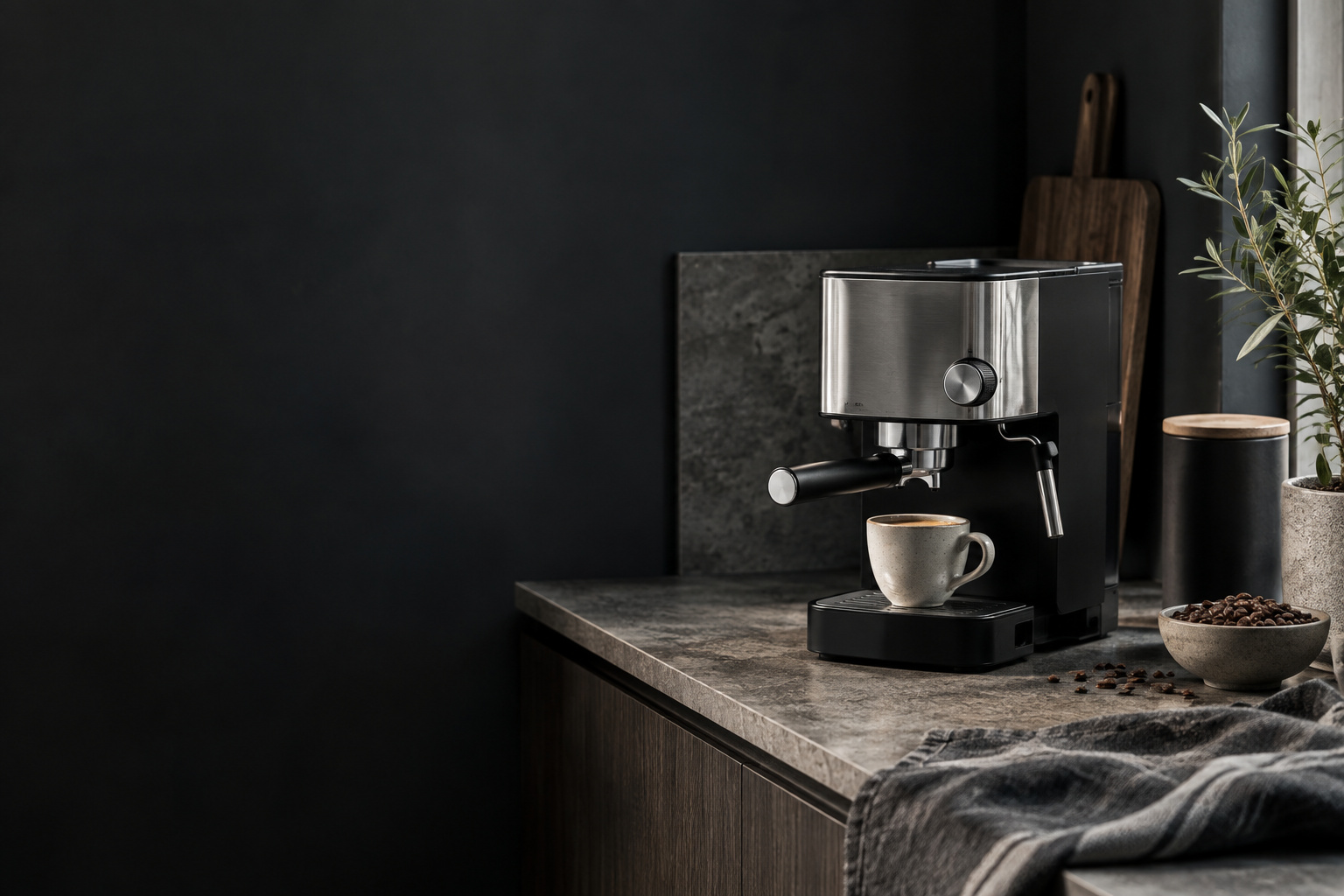
A small espresso station needs room for movement as well as appliances. Plan where hands, water, grounds and removable parts travel before choosing a machine. This guide uses a simple counter dry run to reveal awkward steps, with no invented clearance dimensions or claims that a particular kitchen layout fits every model.
Draw the usable counter, including its interruptions
Measure the space you can actually dedicate to coffee. Mark the sink, stove, cabinet doors, outlets and any area that must remain clear for another household task. Include the front edge and the route people use through the kitchen. A counter that looks empty in a photograph may be busy every breakfast time, so plan around its ordinary use.
Make paper outlines for the equipment using documented dimensions. Do not add an arbitrary safety clearance and call it a manufacturer requirement; look up those requirements for the exact appliances. Leave questions unresolved if the documentation is incomplete. Put the outlines on the counter and open nearby doors. Imagine preparing coffee while someone else reaches the sink or refrigerator. This exercise is a layout decision, not a test of electrical suitability. Check electrical requirements and safe placement through the appliance instructions, and seek qualified help for any question about the installation.

Follow the morning sequence with empty, cool equipment
Walk through taking out a cup, filling the tank as directed, preparing coffee, inserting the portafilter and removing the finished drink. Then imagine emptying the drip tray and putting away tools. Use empty containers for this planning exercise rather than running a hot machine in an unfinished arrangement. Notice where your hands cross, where a door blocks movement and where you have nowhere to set a part down.
The Bambino manual specifies stable, level placement away from a counter edge. Read the corresponding safety and placement guidance for whichever model you choose. Our compact machine checklist explains why body width is only one buying consideration. If you must shift the appliance every time you need the tank, reconsider the location before assuming that daily moving will be acceptable. Check the instructions for moving and handling rather than treating a small machine as a portable object during operation.
Give dry preparation and cleanup distinct places
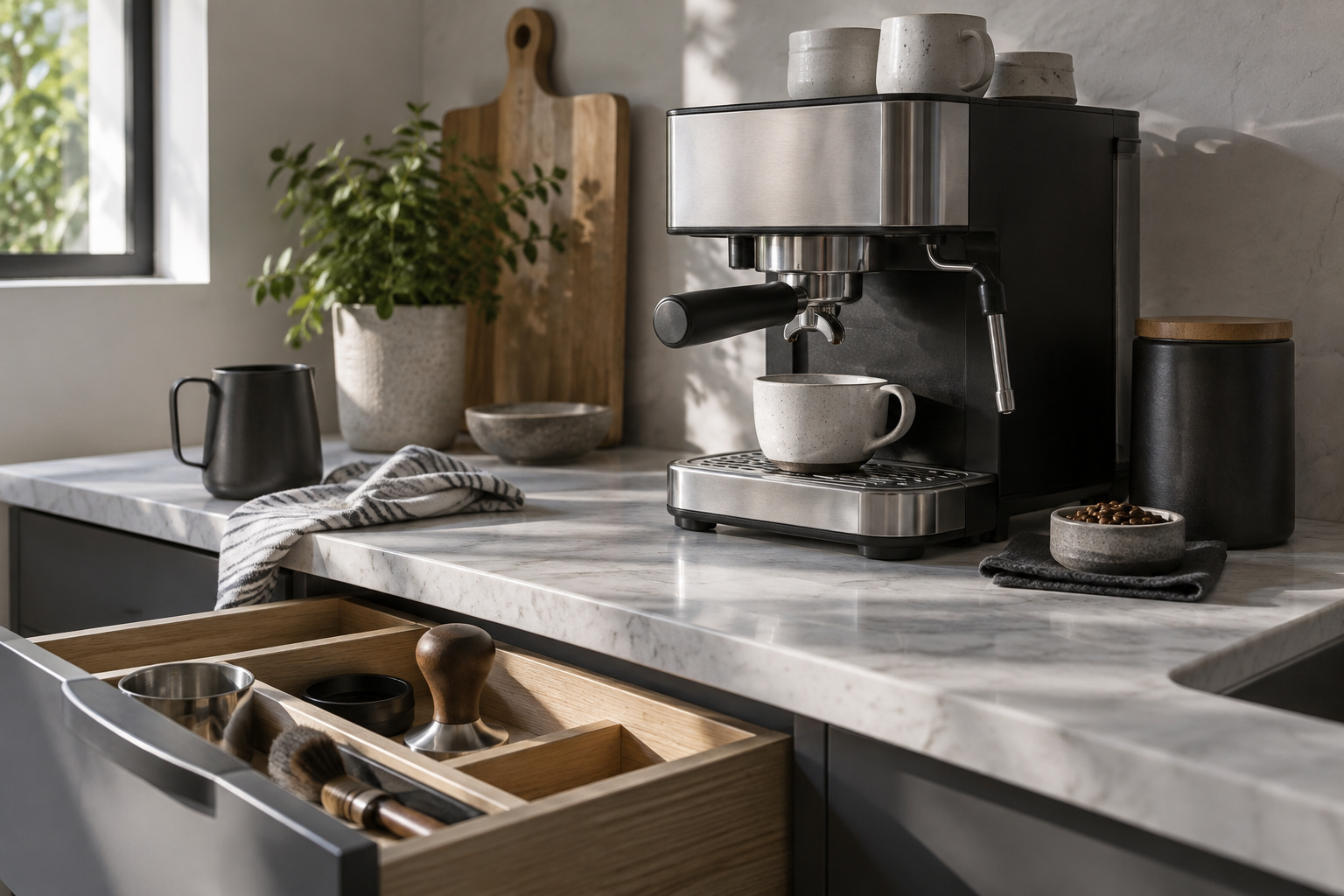
Choose a spot for measuring and preparing coffee and another place for used or wet items. They can be small areas, but each should have an obvious purpose. Keep a stable resting place for the portafilter and any receiving cup. Decide where spilled grounds will go so the cleanup does not require moving every appliance on the counter.
If a grinder is part of the station, plan the transfer to the basket with the actual supplied container or verified holder. Our grinder workflow guide helps compare those arrangements. Resist filling the counter with tools before you know which ones you use. A drawer can hold occasional accessories, while everyday pieces should be easy to identify and retrieve. Store maintenance chemicals separately from coffee ingredients and drinking vessels according to their labels. An attractive matching jar is not worth losing the original product identity or instructions.
Make the milk path and shared use explicit
For milk drinks, reserve a clear route between the refrigerator, the machine and the cleanup area. Check the manufacturer's requirements for the pitcher and wand movement. Do not plan on extending a hot operation over the counter edge because another appliance occupies the proper working space. The milk preparation guide explains why the post-use sequence belongs in the same plan as steaming.
A shared station also needs a visible definition of finished. Decide where clean tools return and how someone can tell that a maintenance task is still in progress. Keep the relevant instructions accessible rather than hidden in a box elsewhere. If one person changes grinder settings, agree on a simple record so the next person does not have to guess what happened. These are household choices, not technical specifications, but they often determine whether a compact setup stays manageable after the novelty of the purchase fades.
Review the plan before buying storage or accessories
Run through the ordinary sequence once more after removing anything that has no clear daily role. Ask whether each planned purchase solves a problem you observed. A tray might organize small tools, but confirm that it does not obstruct ventilation, movement or access specified by the equipment maker. A storage shelf needs its own suitable installation and should not encourage reaching over hot equipment.
The machine-category products on this page are options to investigate once you know the space and workflow requirements.
- Their ratings reflect documented listing data; we have not measured their operating performance or tested them in your kitchen.
- Verify exact dimensions, regional requirements and included parts through current documentation before purchase.
- Keep a sketch with those facts and the unresolved questions.
- A successful small station is not the one that fits the greatest number of coffee objects.
- It is the one that supports your usual drink, leaves the kitchen usable and can be cleaned without dismantling the arrangement every morning.
| Section | Key point |
|---|---|
| Draw the usable counter, including its interruptions | Leave questions unresolved if the documentation is incomplete. |
| Follow the morning sequence with empty, cool equipment | Then imagine emptying the drip tray and putting away tools. |
| Give dry preparation and cleanup distinct places | Our grinder workflow guide helps compare those arrangements. |
| Make the milk path and shared use explicit | Check the manufacturer's requirements for the pitcher and wand movement. |
| Review the plan before buying storage or accessories | Ask whether each planned purchase solves a problem you observed. |